
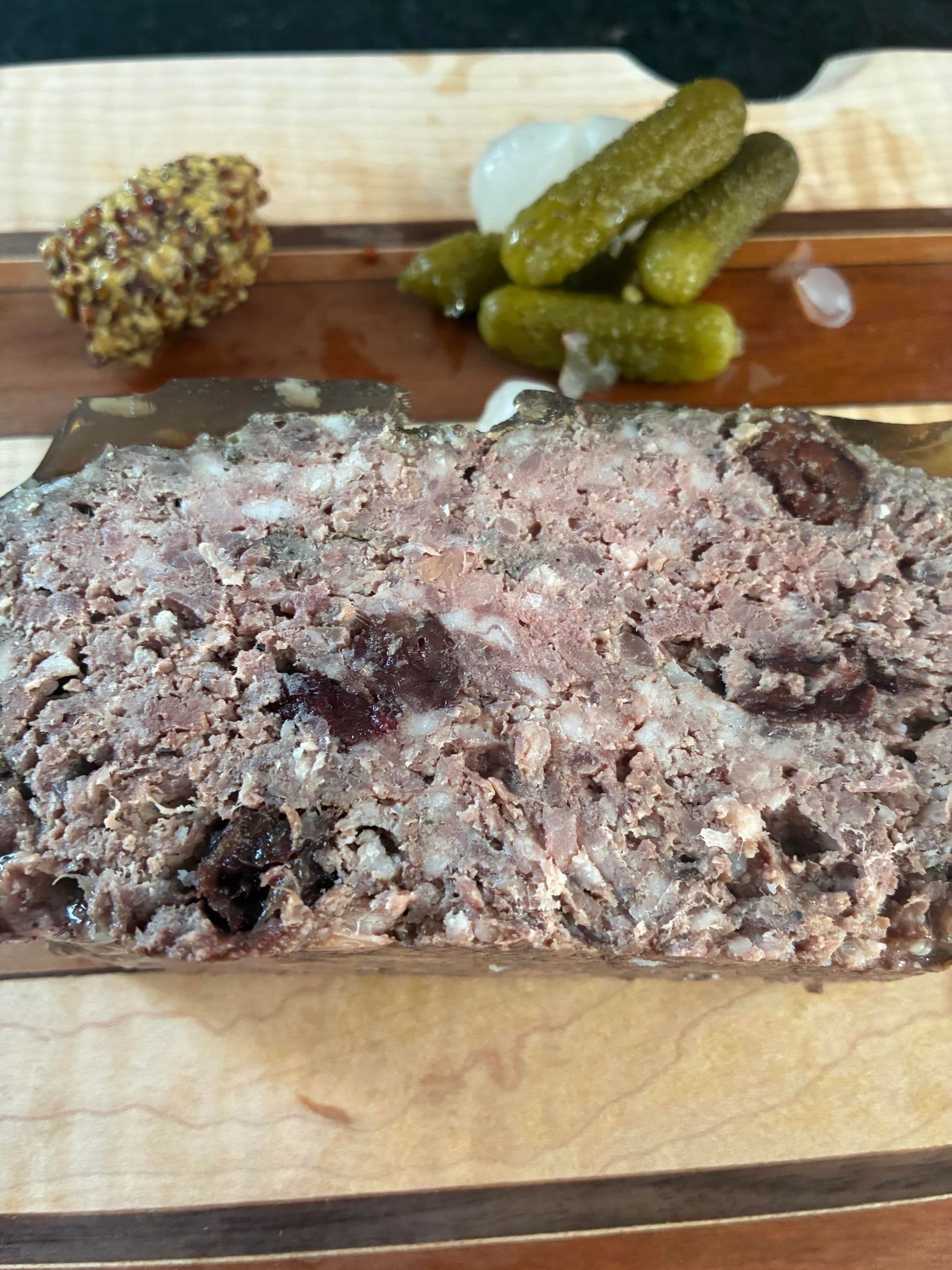
Black Bear and Duck Terrine with Franklin Whisky
Boreal charcuterie that takes patience. And rewards it.
Prep1 h
Cook2 h
Yield6 to 8 servings
LevelIntermediate
Ingredients
Meats
- Ground bear, ground on the coarse plate1½ lb
- Pork fat, ground on the coarse plate12 oz
- Duck hearts, ground on the coarse plate5.3 oz
- Poultry livers, finely hand-cut with a knife, not ground5.3 oz
For the maceration
- Franklin Origin 67/33 Whisky, from Maison Sivo, or another quality Canadian rye0.4 cup
- Dried cranberries, 1/4 cup¼ cup
- Ground dune pepper, 2 teaspoons, from Gourmet Sauvage2 tsp
- Juniper berries, crushed, 1 1/2 teaspoons1.4 tsp
- Fine sea salt20 g
- Ground black pepper8 g
Binding
- French shallot, finely minced2
- Garlic clove, minced2
- Fresh thyme, 1 tablespoon1 tbsp
- Egg2
- Heavy cream 35%⅓ cup
Finishing jelly
- Water, 1 1/4 cup1.3 cups
- Franklin Origin 67/33 Whisky, 1/2 cup½ cup
- Maple syrup, 1/4 cup¼ cup
- Unflavored gelatin powder, 1 standard packet7 g
Steps
- 01Pass the bear meat, pork fat and duck hearts through a meat grinder on the coarse plate. You want a chunky texture, not a paste. The poultry livers, on the other hand, you hand-cut finely with a knife separately — in the grinder they'd turn to mush and lose their signature texture.
- 02In a large stainless steel bowl, combine all the meats (ground and hand-cut) with the dried cranberries, dune pepper, crushed juniper, salt and black pepper. Pour the Franklin whisky over everything and mix by hand for 2 minutes so every piece is coated. Cover with plastic wrap and rest in the refrigerator 12 to 24 hours. The longer it sits, the more the bear's sweetness absorbs the aromas.
- 03The next day, pull the mixture from the fridge. Stir in the minced shallots, garlic, thyme, eggs and 35% cream. Work vigorously by hand for 3 to 4 minutes, kneading like you're working bread dough. You want the mass to turn distinctly tacky — that's what gives the terrine its cohesion after cooking. If the mixture holds together as a ball without crumbling, you're good.
- 04Before packing into the terrine, cook a small test patty of the mixture in a skillet for 2 minutes. Taste. This is the only moment you can adjust — salt, pepper, maybe a touch more whisky. Once it's cooked in the terrine, it's too late.
- 05Preheat the oven to 300°F (150°C). Pack the mixture firmly into a ceramic or cast-iron terrine mold, pressing out air pockets. Cover with the terrine's lid (or aluminum foil). Set the terrine in a larger baking dish and pour boiling water up to halfway up the mold. Bake 1 h 30 to 2 h, until a probe thermometer in the center reads 160°F (70°C).
- 06Pull the terrine from the oven and let it cool at room temperature for 30 minutes. Uncover and lay a wooden board or small dish cut to the mold's shape on top. Set a weight on it (two cans of tomatoes work great). Refrigerate 12 hours minimum. This step compacts the terrine and presses out excess fat.
- 07In a small saucepan, combine the water, Franklin whisky and maple syrup. Bring to a boil, then remove immediately from the heat. Sprinkle the gelatin packet onto the hot liquid and whisk gently for 1 minute to fully dissolve. Let cool 10 minutes — the jelly should still be liquid but no longer scalding.
- 08Pull the terrine from the fridge and remove the press. Smooth the top of the terrine with a spatula if needed. Gently pour the warm jelly over, in a 5 to 8 mm layer. The jelly will fill the gaps and give that glossy bistro-terrine finish. Return to the fridge 4 hours minimum to let the jelly fully set.
- 09Briefly dip the mold in hot water for 10 seconds to ease unmolding. Flip onto a board. Slice with a very sharp knife into 1 cm slabs. Serve with toasted country bread, elderberry pickles (Gourmet Sauvage), strong mustard, and a glass of the same Franklin whisky to close the loop.